

Data analytics has become one of the most important career fields in the modern economy. Businesses, healthcare organizations, financial institutions, government agencies, technology companies, and other employers increasingly rely on data analysts to turn large amounts of information into actionable insights.
But how much does a data analyst actually make in the United States?
The answer depends heavily on location, experience, industry, education, technical skills, and job title.
Current salary sources put the national average for data analysts in the United States in the mid-$80,000s, although estimates vary by methodology. Indeed reports an average base salary of about $86,572 per year, while Salary.com reports approximately $85,646 for its data analyst salary measure.
Location can make a significant difference. Salary.com, for example, reports average salaries above $100,000 in several high-paying markets, while lower-paying states can be considerably below that level.
This guide breaks down data analyst salaries by state, explains why salaries differ across the country, and looks at how you can increase your earning potential as a data analyst.
What Does a Data Analyst Do?
A data analyst collects, cleans, analyzes, and interprets data to help organizations make better decisions.
Typical responsibilities include:
- Collecting data from different sources
- Cleaning and organizing datasets
- Identifying trends and patterns
- Creating reports and dashboards
- Performing statistical analysis
- Building data visualizations
- Writing SQL queries
- Presenting findings to stakeholders
- Supporting business decisions with data
Common tools used by data analysts include:
- Microsoft Excel
- SQL
- Python
- R
- Power BI
- Tableau
- Google Analytics
- Looker
- Databases and cloud platforms
The exact responsibilities depend on the employer and industry.
How Much Does a Data Analyst Make in the USA?
As of 2026, current salary sources generally place average U.S. data analyst pay around $82,000–$87,000 per year, although individual salaries can be significantly higher or lower.
Indeed reports an average base salary of $86,572, with a reported range of approximately $53,731 to $139,484.
Salary.com reports an average of about $85,646 for its data analyst salary measure, with the 25th-to-75th percentile range around $74,729 to $98,020.
Another Salary.com listing gives a higher average estimate of approximately $97,717, illustrating why salary figures can differ depending on methodology, job definitions, and data sources.
Typical U.S. salary range
A practical way to think about the market is:
- Entry-level: roughly $50,000–$70,000
- Mid-level: roughly $70,000–$100,000
- Senior: roughly $90,000–$130,000+
- Highly specialized/lead roles: potentially $120,000–$150,000+
These are broad market ranges rather than guaranteed salaries.
Data Analyst Salary by State
Salary estimates vary considerably depending on the source. The table below uses current Salary.com state estimates as a consistent comparison across states. These figures represent average annual salary estimates, not guaranteed salaries.
| Rank | State | Average Data Analyst Salary |
|---|---|---|
| 1 | District of Columbia | $108,192 |
| 2 | California | $107,782 |
| 3 | Massachusetts | $106,346 |
| 4 | Washington | $105,955 |
| 5 | New Jersey | $105,916 |
| 6 | Alaska | $105,779 |
| 7 | Connecticut | $104,430 |
| 8 | New York | $103,883 |
| 9 | Hawaii | $102,134 |
| 10 | Rhode Island | $101,313 |
| 11 | Maryland | $100,756 |
| 12 | Minnesota | $99,994 |
| 13 | Colorado | $99,701 |
| 14 | Illinois | $99,603 |
| 15 | Oregon | $99,232 |
| 16 | Delaware | $98,958 |
| 17 | New Hampshire | $98,786 |
| 18 | Virginia | $98,401 |
| 19 | Pennsylvania | $97,277 |
| 20 | Nevada | $96,711 |
| 21 | North Dakota | $96,525 |
| 22 | Michigan | $96,232 |
| 23 | Wisconsin | $96,124 |
| 24 | Vermont | $95,909 |
| 25 | Texas | $95,313 |
| 26 | Maine | $95,274 |
| 27 | Arizona | $95,216 |
| 28 | Ohio | $95,147 |
| 29 | Georgia | $94,248 |
| 30 | Indiana | $93,799 |
| 31 | Wyoming | $93,711 |
| 32 | Utah | $93,574 |
| 33 | Iowa | $93,515 |
| 34 | Kansas | $93,046 |
| 35 | Louisiana | $92,909 |
| 36 | North Carolina | $92,861 |
| 37 | Missouri | $92,841 |
| 38 | Florida | $92,460 |
| 39 | Montana | $92,255 |
| 40 | Nebraska | $92,059 |
| 41 | Kentucky | $91,952 |
| 42 | South Carolina | $91,561 |
| 43 | Tennessee | $91,317 |
| 44 | Idaho | $91,219 |
| 45 | New Mexico | $90,506 |
| 46 | Oklahoma | $90,349 |
| 47 | Alabama | $89,773 |
| 48 | South Dakota | $88,805 |
| 49 | Arkansas | $88,278 |
| 50 | West Virginia | $87,994 |
| 51 | Mississippi | $87,144 |
Source: Salary.com, August 2026 salary estimates.
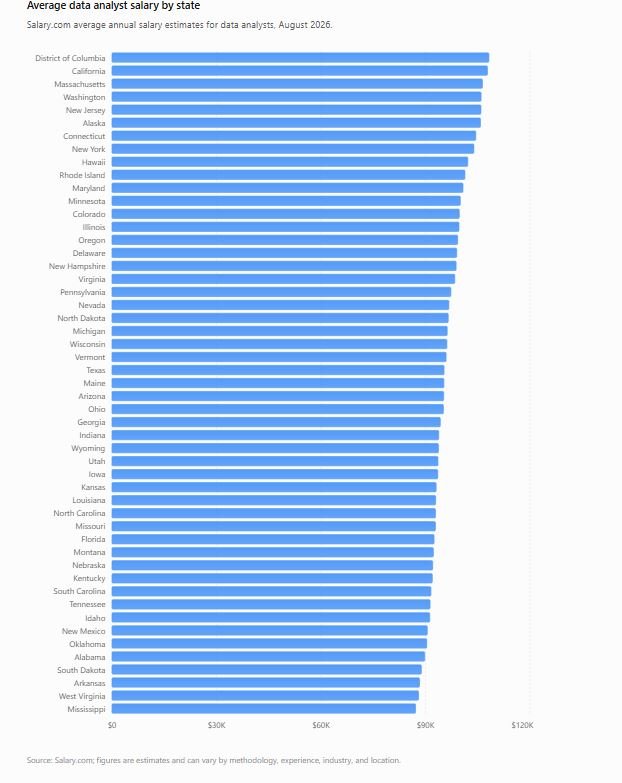
Top-Paying States for Data Analysts
According to the Salary.com estimates above, the highest-paying locations include:
1. District of Columbia — $108,192
Washington, D.C. has a large concentration of federal agencies, contractors, consulting firms, technology companies, nonprofits, and organizations that rely heavily on data.
2. California — $107,782
California has major technology, healthcare, finance, entertainment, and biotechnology industries.
3. Massachusetts — $106,346
Massachusetts benefits from its technology, healthcare, biotechnology, education, and financial sectors.
4. Washington — $105,955
Washington has a strong technology ecosystem and major employers across software, cloud computing, retail, and aerospace.
5. New Jersey — $105,916
New Jersey benefits from its proximity to New York City and its strong pharmaceutical, healthcare, finance, technology, and business sectors.
6. Alaska — $105,779
Alaska appears high in Salary.com’s state estimates, although relatively small labour markets mean salary averages should be interpreted carefully.
7. Connecticut — $104,430
Connecticut has significant financial services, insurance, healthcare, and professional-services employment.
8. New York — $103,883
New York offers opportunities across finance, technology, healthcare, media, consulting, and government.
What Is the Lowest-Paying State for Data Analysts?
In the Salary.com estimates used for this comparison, Mississippi has the lowest average salary at approximately $87,144, followed by West Virginia and Arkansas.
However, a lower nominal salary does not necessarily mean a worse financial outcome.
Cost of living is an important consideration.
A $90,000 salary in a relatively affordable area may provide more purchasing power than a $110,000 salary in an extremely expensive metropolitan area.
Data Analyst Salary in California
California is one of the highest-paying markets for data analysts.
Salary.com estimates an average salary of approximately $107,782.
California’s technology ecosystem creates opportunities in:
- Software
- Artificial intelligence
- Healthcare
- Finance
- Biotechnology
- E-commerce
- Entertainment
Major technology markets such as the San Francisco Bay Area can command particularly high salaries.
However, California also has some of the highest housing and living costs in the country.
Data Analyst Salary in New York
New York is another major market for data professionals.
Salary.com estimates an average data analyst salary of approximately $103,883.
Industries hiring data analysts include:
- Banking
- Investment management
- Insurance
- Healthcare
- Retail
- Consulting
- Technology
New York City can offer significantly higher salaries than smaller markets, but living expenses can also be substantially higher.
Data Analyst Salary in Texas
Texas has become an increasingly important technology and business market.
Salary.com estimates an average data analyst salary of about $95,313.
Major employment centers include:
- Austin
- Dallas
- Houston
- San Antonio
Texas offers opportunities across technology, energy, healthcare, finance, logistics, and manufacturing.
Data Analyst Salary in Florida
Florida’s data analyst market spans:
- Healthcare
- Tourism
- Finance
- Insurance
- Logistics
- Technology
- Government
Salary.com estimates an average salary of approximately $92,460.
Florida can be attractive to professionals because of its large economy and expanding technology and healthcare sectors.
Data Analyst Salary in Virginia
Virginia is another strong market for data analysts.
Salary.com estimates an average annual salary of approximately $98,401.
Northern Virginia is particularly important because of its concentration of:
- Government contractors
- Technology companies
- Cybersecurity organizations
- Consulting firms
- Defense companies
- Federal agencies
The Washington, D.C. metropolitan area also contributes to strong demand for analytical and technology professionals.
Data Analyst Salary in Maryland
Maryland has a strong market for data and technology professionals.
Salary.com estimates average data analyst pay at approximately $100,756.
Maryland’s economy includes:
- Healthcare
- Biotechnology
- Government
- Defense
- Cybersecurity
- Research
- Technology
The proximity of many Maryland communities to Washington, D.C., can also expand employment opportunities.
Why Do Data Analyst Salaries Differ by State?
There isn’t one national salary for data analysts.
Several factors influence compensation.
1. Cost of Living
Employers in expensive metropolitan areas often pay more to attract workers.
2. Industry
A data analyst working in finance may earn differently from one working in education or nonprofit organizations.
3. Experience
Experienced analysts generally earn more than entry-level analysts.
4. Technical Skills
Advanced skills can increase your market value.
5. Company Size
Large corporations may offer higher compensation packages than smaller organizations.
6. Job Title
“Data Analyst” is a broad category.
You may find titles such as:
- Business Data Analyst
- Healthcare Data Analyst
- Financial Data Analyst
- Product Analyst
- Marketing Analyst
- Senior Data Analyst
- BI Analyst
- Data Analytics Consultant
Entry-Level Data Analyst Salary
Entry-level data analysts typically earn less than experienced professionals.
A reasonable broad market range is approximately $50,000 to $70,000, although salaries can fall outside this range depending on location and industry.
The strongest candidates often have:
- A bachelor’s degree
- Internship experience
- SQL skills
- Excel skills
- Power BI or Tableau
- Basic statistics
- Portfolio projects
A master’s degree can be helpful for certain roles, but it is not required for every data analyst position.
Mid-Level Data Analyst Salary
After several years of professional experience, analysts can potentially move into the $70,000–$100,000+ range.
At this stage, professionals are expected to do more than produce reports.
They may:
- Design analytical solutions
- Work directly with business leaders
- Build complex dashboards
- Automate reporting
- Develop forecasting models
- Manage projects
- Mentor junior analysts
Senior Data Analyst Salary
Senior data analysts can potentially earn $90,000–$130,000 or more, depending on their skills, employer, and location.
Senior professionals may specialize in:
- Data strategy
- Business intelligence
- Product analytics
- Healthcare analytics
- Financial analytics
- Marketing analytics
- Advanced statistics
Some senior analysts eventually transition into:
- Analytics Manager
- Data Scientist
- Data Engineer
- BI Manager
- Analytics Consultant
- Data Product Manager
Highest-Paying Industries for Data Analysts
The industry you choose can significantly affect your compensation.
Technology
Technology companies generate enormous amounts of data and frequently need analytical professionals.
Finance
Banks, investment firms, insurance companies, and fintech organizations rely heavily on data.
Healthcare
Healthcare organizations use analytics for:
- Patient outcomes
- Cost management
- Claims analysis
- Clinical operations
- Population health
Consulting
Consultants may work with multiple clients and industries.
Government
Federal and state agencies employ analysts for policy, operations, finance, healthcare, and program evaluation.
E-Commerce
Online retailers rely on analytics for:
- Customer behavior
- Pricing
- Marketing
- Inventory
- Product performance
Data Analyst vs Data Scientist Salary
Data scientists generally have a different role from data analysts.
Data Analyst
Focuses on:
- Reporting
- Dashboards
- Business questions
- Data exploration
- Descriptive analytics
Data Scientist
Often focuses on:
- Machine learning
- Predictive modeling
- Statistical modeling
- Advanced experimentation
- Artificial intelligence
Because data scientists often require more advanced technical and mathematical skills, compensation can be higher.
However, the two careers overlap considerably, and experienced data analysts can sometimes transition into data science.
Data Analyst vs Business Analyst
These jobs are often confused.
A data analyst primarily works with datasets to identify trends and insights.
A business analyst typically focuses more on business processes, requirements, systems, and organizational improvements.
There is significant overlap, and some employers use the titles differently.
Skills That Can Increase a Data Analyst Salary
If you want to move toward higher-paying data analyst positions, focus on skills employers actually use.
SQL
SQL remains one of the most important skills for working with databases.
Python
Python can help with:
- Data cleaning
- Automation
- Statistical analysis
- Machine learning
Power BI
Power BI is widely used for business intelligence and dashboard development.
Tableau
Tableau is another major visualization platform.
Excel
Advanced Excel remains valuable, particularly in finance, operations, healthcare, and business environments.
Statistics
Understanding statistics helps analysts interpret data correctly.
Cloud Computing
Knowledge of platforms such as AWS, Azure, and Google Cloud can expand your opportunities.
Machine Learning
Machine learning can help analysts transition into more advanced analytics roles.
How to Increase Your Data Analyst Salary
Getting a degree is only the beginning.
Build a Portfolio
Create projects that demonstrate real analytical skills.
Learn SQL
Become comfortable with joins, CTEs, window functions, subqueries, and optimization.
Master a Visualization Tool
Power BI and Tableau are useful choices.
Learn Python
Python can differentiate you from analysts who only use spreadsheets.
Specialize
Healthcare, finance, cybersecurity, marketing, and product analytics can provide different career opportunities.
Negotiate
Research market salaries before accepting an offer.
Change Roles Strategically
Sometimes the largest salary increases come from changing employers or moving into a more specialized position.
Is Data Analytics a Good Career in 2026?
For many people, yes.
Data analytics provides a combination of:
- Strong employer demand
- Transferable skills
- Multiple industries
- Career progression
- Remote and hybrid opportunities
- Opportunities to specialize
- Potential transition into data science or engineering
The U.S. Bureau of Labor Statistics’ Occupational Employment and Wage Statistics program provides annual wage data across states and metropolitan areas for hundreds of occupations, making it a useful source for researching geographic compensation differences.
One important caveat is that “data analyst” is not always treated as a single standardized occupation in federal labour statistics. Different salary websites may classify related roles differently, which is one reason salary estimates vary.
Frequently Asked Questions
What is the average data analyst salary in the USA?
Current salary sources generally place the average around $82,000–$87,000 per year, although estimates vary by methodology. Indeed currently reports about $86,572, while Salary.com reports around $85,646 for its main data analyst estimate.
Which state pays data analysts the most?
Salary.com currently ranks the District of Columbia, California, Massachusetts, Washington, and New Jersey among the highest-paying locations for data analysts.
Can a data analyst make $100,000?
Yes. Data analysts can reach six-figure salaries, particularly with experience, specialized skills, strong industries, and employment in higher-paying markets.
What is the starting salary for a data analyst?
Entry-level salaries vary widely, but approximately $50,000–$70,000 is a reasonable broad market range. Some positions pay considerably more in high-cost or highly competitive markets.
Which skills pay the most for data analysts?
SQL, Python, statistics, cloud technologies, data visualization, machine learning, and business intelligence skills can help analysts qualify for more advanced positions.
Is data analytics a good career for international students?
It can be. Data analytics is used across many industries and can provide opportunities for international graduates. Students in the United States should also check whether their specific academic program qualifies as a STEM-designated program if STEM OPT eligibility is important to their plans.
Final Thoughts
A career in data analytics can offer strong earning potential and considerable flexibility in the United States.
Current salary estimates show that compensation varies substantially by location. The highest-paying markets tend to include Washington, D.C., California, Massachusetts, Washington, New Jersey, Connecticut, New York, Maryland, and other major business and technology centers.
But salary isn’t the only factor to consider.
A $105,000 salary in an expensive metropolitan area may not necessarily provide more purchasing power than a $90,000 salary in a lower-cost location.
When comparing data analyst jobs, look at the complete compensation package:
Base salary + bonus + benefits + remote flexibility + career growth + cost of living.
And don’t underestimate skills.
A data analyst who combines SQL, Python, Power BI/Tableau, statistics, business knowledge, and industry expertise can position themselves for significantly more advanced opportunities.
If your goal is to reach a six-figure data analytics salary, focus less on finding a single “highest-paying state” and more on developing a skill set that employers in high-value industries are willing to pay for.