
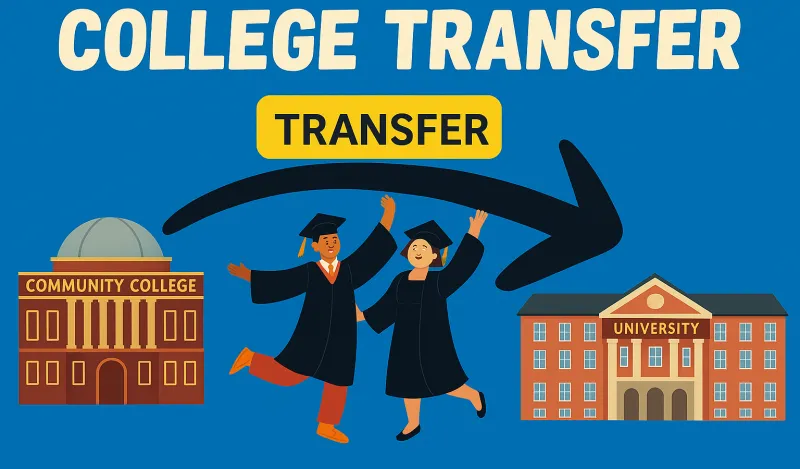

If you’re planning to earn a bachelor’s degree in the U.S. but want a more affordable and flexible starting point, the 2+2 community college transfer program is one of the most popular pathways. It allows students to complete the first two years at a community college and then transfer to a four-year university to finish their degree.
This model can significantly reduce tuition costs while still leading to the same bachelor’s degree as traditional university students.
What is a 2+2 Community College Transfer Program?
A 2+2 transfer program is an academic pathway where students:
- Spend 2 years at a community college
- Earn an associate degree (AA or AS) or complete transferable credits
- Transfer to a 4-year university as a junior
- Complete the final 2 years of a bachelor’s degree
In total, students graduate with a bachelor’s degree in about four years—similar to a traditional university route, but split across two institutions.
This structure is often supported through articulation agreements, which are formal partnerships between community colleges and universities that ensure credits transfer smoothly.
How the 2+2 System Works (Step-by-Step)
1. Start at a Community College (Years 1–2)
You focus on:
- General education courses (English, math, science, etc.)
- Intro courses in your intended major
- Completing ~60 credit hours
Many students also earn an associate degree during this stage.
2. Transfer to a University (Years 3–4)
You apply to transfer to a four-year institution and:
- Enter as a junior (3rd-year student)
- Focus on major-specific courses
- Complete upper-level classes and electives
3. Graduate with a Bachelor’s Degree
Your degree is awarded by the university you transfer to, not the community college.
Why Students Choose 2+2 Programs
1. Lower Cost
Community colleges are significantly cheaper than universities, making this route a major cost-saving strategy.
Many students save thousands in tuition by completing their first two years at a community college.
2. Easier Admission Pathway
Some universities offer:
- Guaranteed transfer admission
- Minimum GPA transfer agreements
- Pre-approved course pathways
3. Flexibility
Students can:
- Stay close to home initially
- Work while studying
- Explore majors before committing fully
4. Same Bachelor’s Degree Outcome
Your bachelor’s degree is identical to that of students who attended all four years at a university.
What Are Articulation Agreements?
An articulation agreement is a formal transfer plan between schools that ensures:
- Courses taken at community college match university requirements
- Credits transfer without loss
- A clear roadmap for graduation
Without these agreements, students risk losing credits or extending their studies.
Pros and Cons of 2+2 Programs
Pros
- Lower tuition costs
- Smaller class sizes in early years
- Easier academic transition
- Flexible entry point into higher education
Cons
- Requires careful planning to avoid credit loss
- Some competitive majors (engineering, nursing) may require strict course alignment
- Transfer admission is not always guaranteed
- Campus experience is split between two institutions
Common Mistakes to Avoid
Many students struggle with 2+2 programs because they:
- Take non-transferable classes
- Change majors too late
- Don’t follow a structured transfer plan
- Ignore advisor guidance
A key rule: Always confirm transfer equivalency before enrolling in classes.
Who Should Consider a 2+2 Program?
This pathway is ideal if you:
- Want to save money on college tuition
- Need a flexible academic start
- Are still deciding on a major
- Prefer smaller classes early on
- Plan to transfer to a state or public university
Best Practices for Success
To maximize your success in a 2+2 program:
- Choose your target university early
- Use transfer equivalency tools
- Follow an official transfer pathway (if available)
- Meet with advisors every semester
- Maintain a strong GPA for transfer admission
Helpful Resources & Official Links
Here are useful resources to explore transfer pathways:
- U.S. Department of Education – College Transfer Information
https://www.ed.gov/ - National Student Clearinghouse Research on Transfers
https://www.studentclearinghouse.org/ - College transfer planning guides
https://www.collegeboard.org/ - Example university transfer pathways (Towson University)
https://www.towson.edu/admissions/undergrad/transfer/community-college-partnerships/agreements.html
Final Thoughts
A 2+2 community college transfer program is one of the most cost-effective ways to earn a U.S. bachelor’s degree. However, success depends heavily on planning, credit transfer accuracy, and choosing the right courses early.
When done correctly, it offers the same degree outcome as a traditional four-year university path—at a significantly lower cost and with greater flexibility.